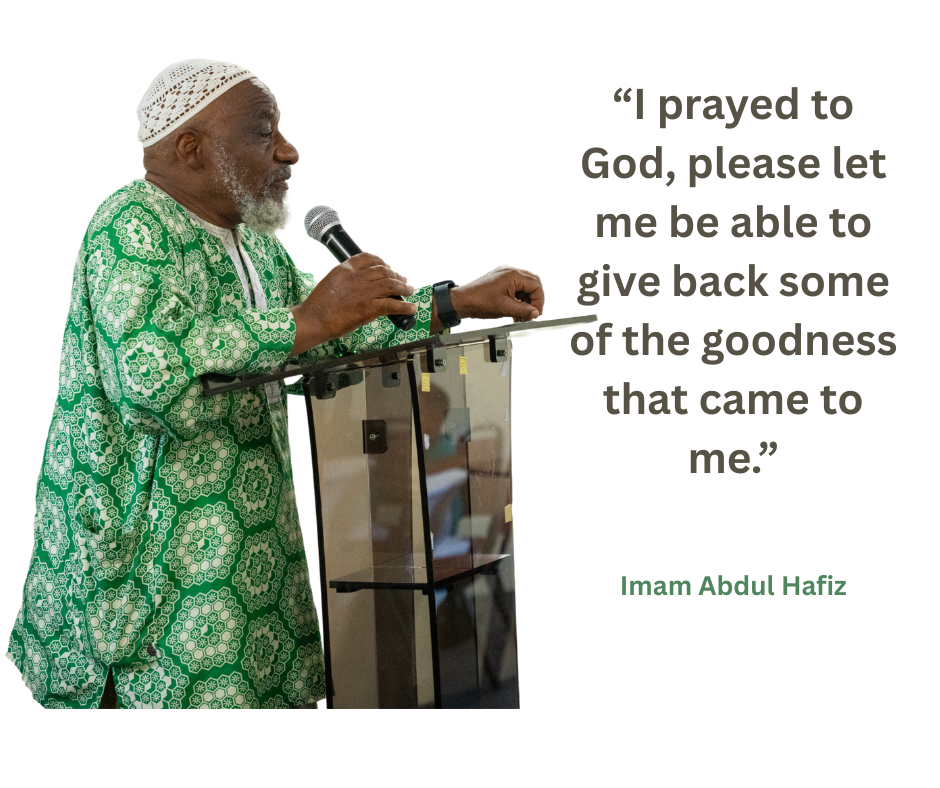


Honoring Imam Abdul Hafiz Life of Service

Naim Shah Jr • April 27, 2026

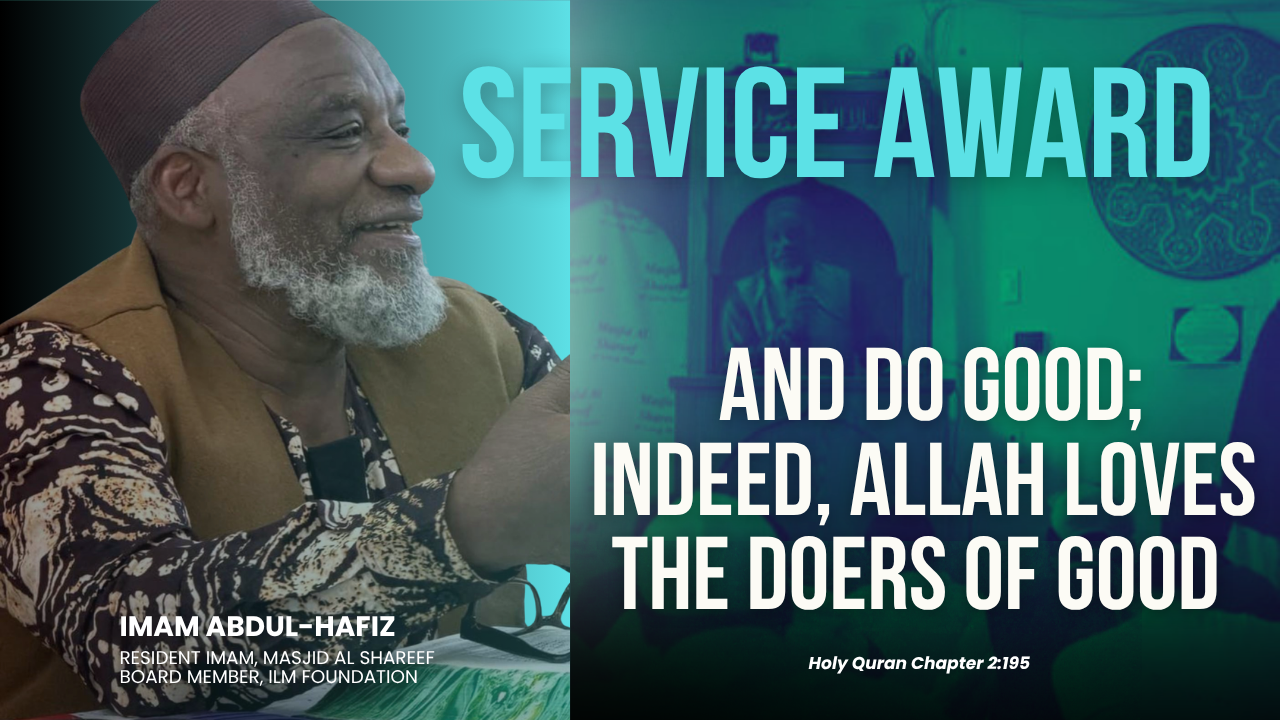
For over 22 years as a Federal Bureau of Prisons Chaplain, and more than 15 years volunteering across county, state, and federal correctional facilities, Imam Abdul Hafiz has committed himself to the mission using Islam to re-build the character of men, many wrote off as expendable.


“I couldn’t foresee anything but another sensation through heroin,” 44-year-old inmate William Walker said of life before prison. But then came Abdul-Hafiz, who “inspired me to find another way. . . . I don’t know what my path would have been if I hadn’t been incarcerated and found Islam.” Source LA Times Article


Imam Hafiz used available resources like the Qur’ans, books, prayer rugs, hijabs, kufis, to build bridge and re-establish trust and hope among the brothers.  He established Islamic libraries, facilitated Ramadan observances, and ensured that incarcerated individuals had access to authentic religious guidance and experiences.


As Director of the Shura Council’s Prison Outreach Program for over a decade, he worked tirelessly to build trust with correctional institutions, navigating complex systems, overcoming skepticism, and opening doors for the broader Muslim community to serve. This work was not easy. It required patience, sacrifice, and resilience. “The challenge is overcoming mistrust and opening your life to constant investigation,” he reflects. “But the mission is greater than the discomfort.”


Honoring Imam Abu Ishaq Abdul Hafiz Life of Service

“The mission is Greater than the Discomfort.”


There are leaders who speak. There are leaders who act. And then there are those rare individuals who quietly dedicate their entire lives to serving humanity often in places the world forgets.


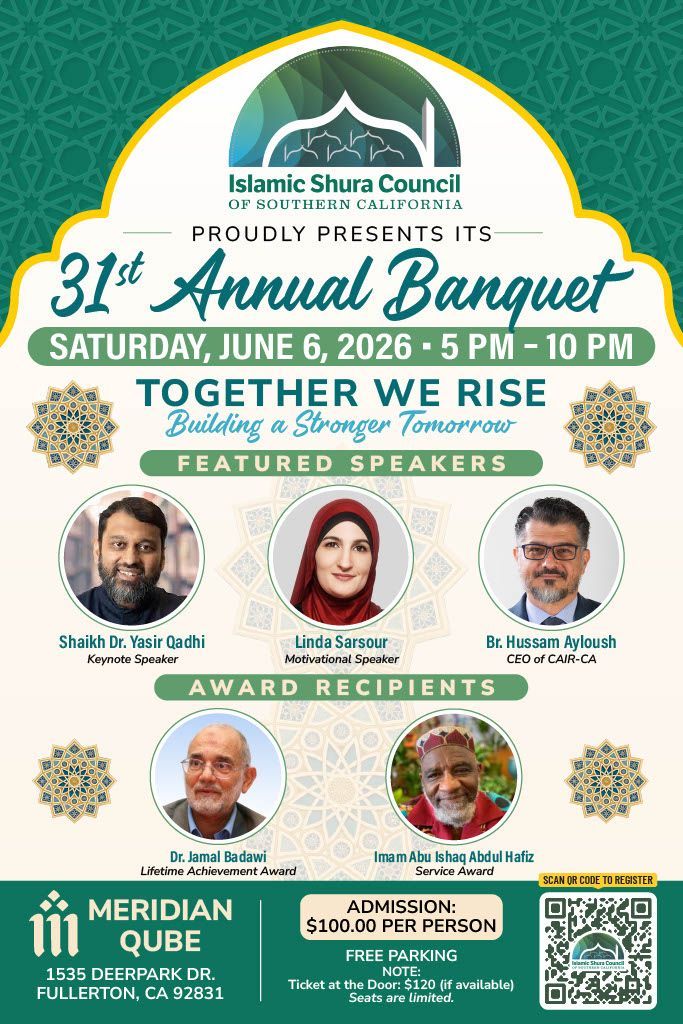
Today, we honor one such servant of God, Imam Abu Ishaq Abdul Hafiz, recipient of the 2026 Community Service Award from the Southern California Shura Council. This is a recognition of a lifetime spent walking into the hardest spaces with faith, dignity, and unwavering compassion, answering the call in spaces few want to go.


But to call this simply an “award” would be an understatement. He is fulling daily the purpose of which the Quran says, “And I did not create the jinn and mankind except to worship Me. (51.56) 


Born Albert Eugene Simms Jr. in Gary, Ind., Abdul-Hafiz discovered Islam during his junior year at Tuskegee Institute in Alabama. “One of my African history professors was a Christian, . . . teaching us the basics of Islam in Africa,” Abdul-Hafiz said. “He said they believed in Jesus as a prophet of God, not God incarnate, and I thought, ‘Wow. All my life I’ve been thinking that. . . . This makes sense to me.’ ” After studying several religions, Abdul-Hafiz took his Islamic oath of faith July 7, 1971, and adopted his Arabic name.

Restoring Humanity Behind Bars

When he was hired at Lompoc, he became only the second imam to work full time in the federal prison system. “I wanted to help those in the least position to have access to Islamic information,” What makes Imam Abdul Hafiz’s work truly transformative is what he awakened within inmates. In environments often defined by isolation and despair, he brought presence.


He reminds us: “Every visit leaves you with a sense of purpose… the joy on their faces is life-changing.” Many of those he served had never been visited by a Muslim before. Many discovered Islam while incarcerated. Many were searching not just for religion but for identity, dignity, and belonging. Through his service, Imam Abdul Hafiz helped restore all three.


Despite this recognition, Imam Abdul Hafiz remains deeply humble. He does not seek praise. He issues a call to action. “These men and women deserve to be valued members of our Ummah. This is not a one-person effort. We must love for our brothers and sisters what we love for ourselves.”


Prison Outreach Services & Beyond

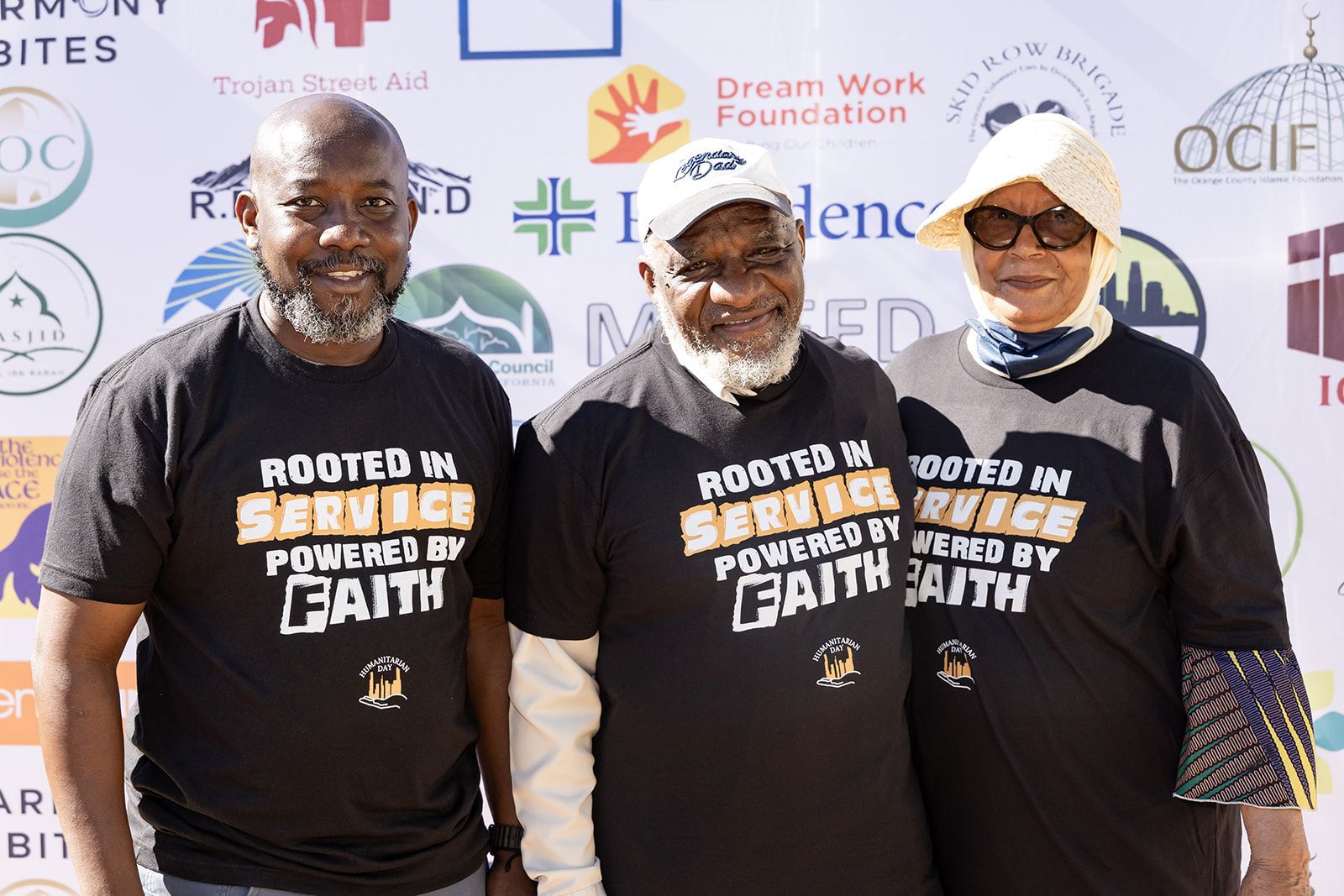
As the resident Imam of Masjid Al Shareef in Long Beach, Imam Abdul Hafiz continues to lead in purpose. His impact extends beyond prison walls through: youth development initiatives, community interfaith partnerships, mentorship and spiritual leadership, and board positions with organizations like the ILM Foundation.

Standing on the Shoulders of Giants


In true humility, Imam Abdul Hafiz attributes his journey to those who came before him Brother Earl Shah, Imam Abdul Kareem Hasan, Imam Jan Diwan, John Fakir, Sister Shaheeda Muhammad, Al Hajj Papa Naim Shah Sr., and most importantly his lifelong partner of over 50 years, Al Hajja Safiya Abdul Hafiz. Their influence lives on through his work.


This award honoring Imam Abdul Hafiz is a reminder that service is not always visible, impact is not always celebrated, and the most meaningful work often happens in the most overlooked places. Imam Abdul Hafiz did not choose the easy path; he embraced the necessary one.


At ILM Foundation, we are proud to stand alongside Imam Abdul Hafiz. He embodies the true essence of service, compassion, and faith in action. His life’s work challenges all of us to ask who are we serving? And more importantly who are we forgetting? Today, we celebrate a Leader who never forgot his Lord, his Messenger, his Religion, his family, and humanity.


“But seek the Home of the Hereafter by means of that which God has bestowed on you; do not forget to take your portion [of the Hereafter] in this world." Be good to others as God has been good to you…” 28.77

Orange

At ILM Foundation, we believe in nourishing bodies and minds. Together, we can create an interconnected community where everyone thrives!

By ILM Foundation May 10, 2026
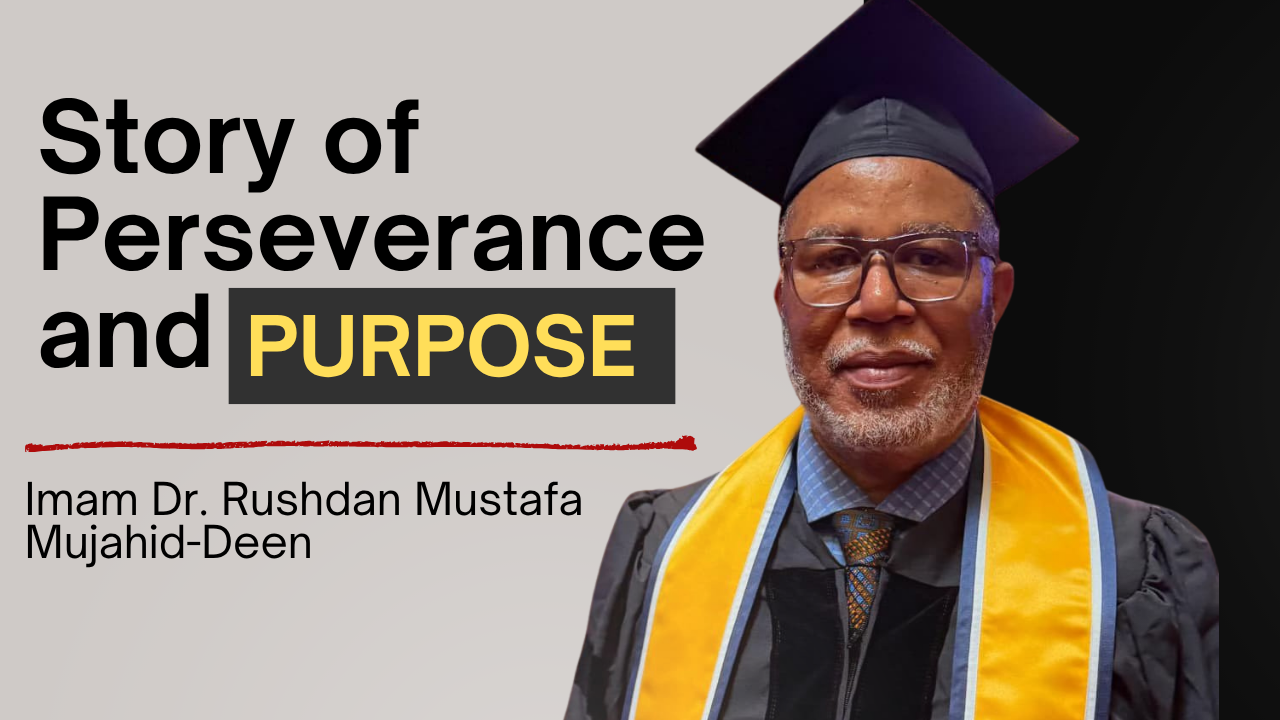
Perseverance to Purpose: Honoring Imam Dr. Rushdan Mustafa Mujahid-Deen His quiet unshakable connection to faith, sacrifice, commitment to service, and personal development. A respected voice in chaplaincy and community service, Imam Rushdan has reached a major milestone earning his Doctor of Ministry (DMin) in Islamic Leadership from Bayan Islamic Graduate School . This achievement is a story of resilience, discipline, and deep spiritual conviction. A Journey Forged Through Struggle and Fait h Balancing two jobs, enduring personal and external challenges, and pushing through moments of doubt, Imam Rushdan remained steadfast. He describes long nights, relentless effort, and a test of patience that would have caused many to step away. At one critical moment , he faced a major setback, not passing his oral defense. For many, this could have marked the end. But not for him, with humility, he returned to his work. He revisited his thesis, leaned on the support of trusted friends, and anchored himself in faith. When he came back to defend his work again, he excelled. "That man can have nothing but what he strives for; That (the fruit of) his striving will soon come in sight.." Quran Chapter 53:39-40

By Naim Shah Jr May 1, 2026
Eid al-Adha & Udhiyah (Qurbani) Guidebook of a Sacred Tradition of Sacrifice, Service, and Compassion Each year, Muslims around the world come together in a powerful expression of faith, generosity, and remembrance for Eid al-Adha, the Festival of Sacrifice. As ILM Foundation prepares for another impactful Qurbani season, this e-guidebook answers the most important questions while inviting you to be part of something deeply meaningful. What is the difference Udhiyah and Qurbani? Udhiyah is the classical Arabic term used in Islamic texts and across the Middle East. It translates to "blood sacrifice" and is derived from Duha (the mid-morning hours when the slaughter occurs). Qurbani is predominantly used in South Asian communities and in Urdu and Persian languages. It is derived from the Arabic word Qurban, which means "to draw near" or "closeness" to Allah. What is Eid al-Adha? Eid al-Adha is one of the two major Islamic holidays, commemorating the unwavering devotion of the Prophet Ibrahim (Abraham). He was tested by God to sacrifice his son, and in his complete submission, he prepared to do so only for God to replace his son with a ram at the last moment. "And when he reached the age of striving alongside him, he said: 'O my dear son, I see in a dream that I am sacrificing you so look, what do you think?' He said: 'O my father, do what you are commanded. You will find me, if Allah wills, among the steadfast……' Quran 37:102 - 107 How is Eid al-Adha celebrated? Eid begins with a special congregational prayer, followed by a sermon. Families gather, meals are shared, and communities come alive with gratitude and generosity. But at the heart of Eid al-Adha is Qurbani, the ritual sacrifice of an animal, symbolizing devotion to God and compassion for others. The importance of the Eid prayer and the sacrifice that follows it is established in the Quran, "Indeed, We have granted you al-Kawthar. So pray to your Lord and sacrifice." Quran 103:1-2 What date is Eid al-Adha 2026? In 2026, Eid al-Adha is expected to begin on Tuesday, May 26, 2026, depending on the sighting of the moon. How many days is Eid al-Adha? Eid al-Adha spans 3 to 4 days, beginning on the 10th day of Dhul Hijjah (the final month of the Islamic calendar) and continuing through the Days of Tashreeq. When does Eid al-Adha end? Eid al-Adha concludes on the 13th of Dhul Hijjah, marking the end of the Days of Tashreeq. Donate Here for your Qurbani

By ILM Foundation April 29, 2026
The Profound Outcome of the Total Submission Qurbani is an act of worship of sacrificing an animal most commonly like a cow, sheep or goat; re-enacting the Sacrifice of Prophet Ibrahim (as) and his Son Prophet Ishmail (as). Eid Al Adha is referred to as Eid Al Akbar (The Big Celebration). ILM Foundation’s aim in this blog is to share some principles associated with this rich tradition and the deep blessings attached to it. Qurbani (قُرْبَانِ) means to draw near. Prophet Ibrahim and his son demonstrate a Divine Master’s Class chronicled in the Quran of Qurbani in practice. Qurbani in the Quran فَلَمَّا بَلَغَ مَعَهُ ٱلسَّعْىَ قَالَ يَـٰبُنَىَّ إِنِّىٓ أَرَىٰ فِى ٱلْمَنَامِ أَنِّىٓ أَذْبَحُكَ فَٱنظُرْ مَاذَا تَرَىٰ ۚ قَالَ يَـٰٓأَبَتِ ٱفْعَلْ مَا تُؤْمَرُ ۖ سَتَجِدُنِىٓ إِن شَآءَ ٱللَّهُ مِنَ ٱلصَّـٰبِرِينَ And when he reached the age of striving alongside him, he said: 'My son I see in a dream that I am slaughtering you. So, tell me, what do you see?' He said: 'My father do what you have been commanded. You will find me, if Allah wills, among the steadfast."
Show More